
The Mountain
On this journey into the unknown we surmount some peak firsts.

It’s been 51 weeks since the love of my life left this Earth. I’ve been living in both his absence and his presence for almost a year. Like ice under snow, or coal inside a stocking. There’s a painful reality within the generous comforts I’ve been given.
One thing I’ve learned from a year of grief is that the purest part of my pain is mine alone to tend. I grieve for my children, I mourn that he’s missing their brilliance, but the most sensitive pain to carry is the loss to myself. That I have lost him remains almost impossible to comprehend.
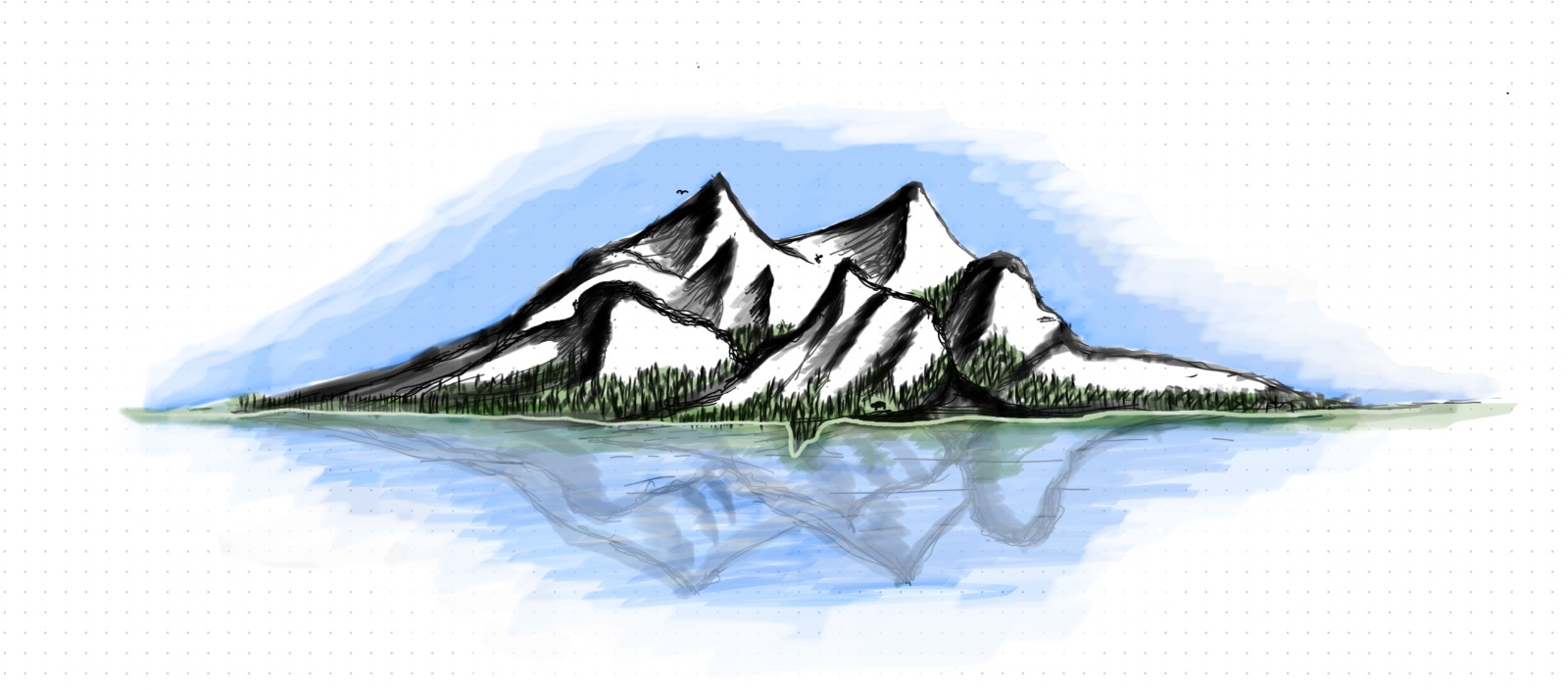
Despite its permanence, my own loss remains curiously unfamiliar. I’m beginning to wonder if perhaps this unwanted path through widowhood is actually an unrequested route into self-hood. Like signposts on a ski hill, grief points to easy, moderate or difficult pistes into ones self. There’s no ‘right’ way to get down the mountain, gravity will do it one way or another (we’re all going to die). Grievers must griever, perhaps the only choice is about speed, safety and enjoyment.
I’ve come to realise that being a widow requires inner agency in an outer context that’s entirely unknown. I didn’t intend to learn more about myself over Christmas, but that’s the gift of the mountain called bereavement. We get to engage in the terrain of life as it is. Not how we want it to be.
A Christmas Audit
After five weeks of Christmas related activities, by December 26th I felt as though I’d been through a marathon length assault course for the bereaved. No singular event was particularly more difficult than any other from 2025. It was the frequency of intense moments which made Christmas an endurance event for me. The inevitability of pain and limited time to recover accumulated into a lactic burn. On par with the summer, which was almost three times longer. Second only to my husband’s funeral. The string of actions which maintained an illusion of normalcy for my children disproportionately drained my nervous system. It’s this deep fatigue which makes me feel that Christmas needs some accounting.
Now that the tree is bare, the decorations are boxed, the mince pies have been eaten and the twinkling lights are off, I think it’s time to review the season. Because it seems to me that Christmas is mostly performative, which is why it’s so depleting. I don’t want to be an Ebenezer who Scroogely undermines its importance. I want only to be truthful with myself, to create a life I can sustain for the future. I’ve started to regularly audit my investment into our life, for the sake of maintaining it. On balance I feel that the effort required by the festive period has been disproportionate to its benefit, for selfish-scrooge-me. Nonetheless I have overall enjoyed it.
I’ve decided that it’s the social constructs which cumulatively expect too much. It’s no one person’s fault. I privately tried to contain Christmas, my family supported those efforts, yet it’s so much bigger than any of us. Fighting the festive season is somewhat pointless. I could see it coming, so I went with it and set boundaries - school concerts, social events, friendly gatherings, cosy family time. It was wonderful to have so much fun-stuff to do. We were glad to be companioned, happy to be hosted, and grateful for every caring gift. But my somewhat cynical auditor report would state a “Qualified Opinion”.
There are some issues in my account balance, the logistical operations are unsustainable, the system is especially vulnerable due to an excess of alcohol and there are specific limitations in the process, because it relies solely on one parent. Although not sufficiently pervasive to warrant an overall negative opinion, these concerns are fair reason for any autonomous adult to want to opt out. Put simply, Christmas was an over-investment from me for the sake of my children.
Quiet Survival
Mark navigated last Christmas while containing the quiet understanding that his life would be less if he missed any family moment. It wasn’t really about Christmas for him, it was about family. The construct of Christmas supported his acceptance that he could not control any of it. He gave his weight to the festive frame, set his focus on the task of staying alive and let everything else happen around him. At any point he may have had to go to hospital, knowing that it would be a destination from which he’d never return. In the end, that transfer happened 4 days after Christmas on December 29th. In the moment, nothing and no-one could stop him from engaging with those he loved, as much as his body would allow.
This year, to find enough fortitude to endure the festive season, I tried to follow his example. I engaged my willingness to enjoy it all, without him. And if I wasn’t enjoying it then I did something else. It sounds like an underwhelmingly achievable endeavour, but in reality it’s difficult to do. Quiet survival requires continuous presence; confident control of the situation: the ability to say “no” or stop; the willingness to slow down; intelligence to read the landscape; being silent for long enough to hear the signals; doing the next best thing, even if it’s difficult or unpopular. I had to remember how to have fun; keep breathing.
Second by second, minute by minute I kept myself alive this Christmas. And then in week six of my merry perseverance, I realised how the whole year had been an intense training exercise for a week away with the kids. After Christmas we went skiing.
Let’s Go
Just weeks after Mark died, I marked December 26th 2025 in my calendar as an all-day event called “packing”. Our friends asked me in February, as soon as they felt able, “Do you want to come skiing next Christmas? We’re leaving on the 27th.” I said, “Yes” without hesitation. The cost and logistics were irrelevant to my broken heart. They were asking so we were going. These were friends I could trust to look after me in what I feared would be one of the most fragile windows of my heartbreak. I also knew that they could look after my kids, if necessary. If I fell apart as “the anniversaries” began to arrive I needed a safety net which was capable of catching the emotional whole of my kids.
I needed that ski holiday to guide me through the difficult off-piste terrain of 2025. It kept me going, lifted my head and called me onwards. Because being +2000m above sea level, in the French Alps, would have been the best week of Mark’s year. In any version of the future he didn’t live, regardless of how 2025 had gone for him, dead or alive, good or bad, with me or separated, he’d be there. Skiing was his thing. I knew that I would deeply feel his presence in the mountains, and I wanted that more than anything.
Loving It
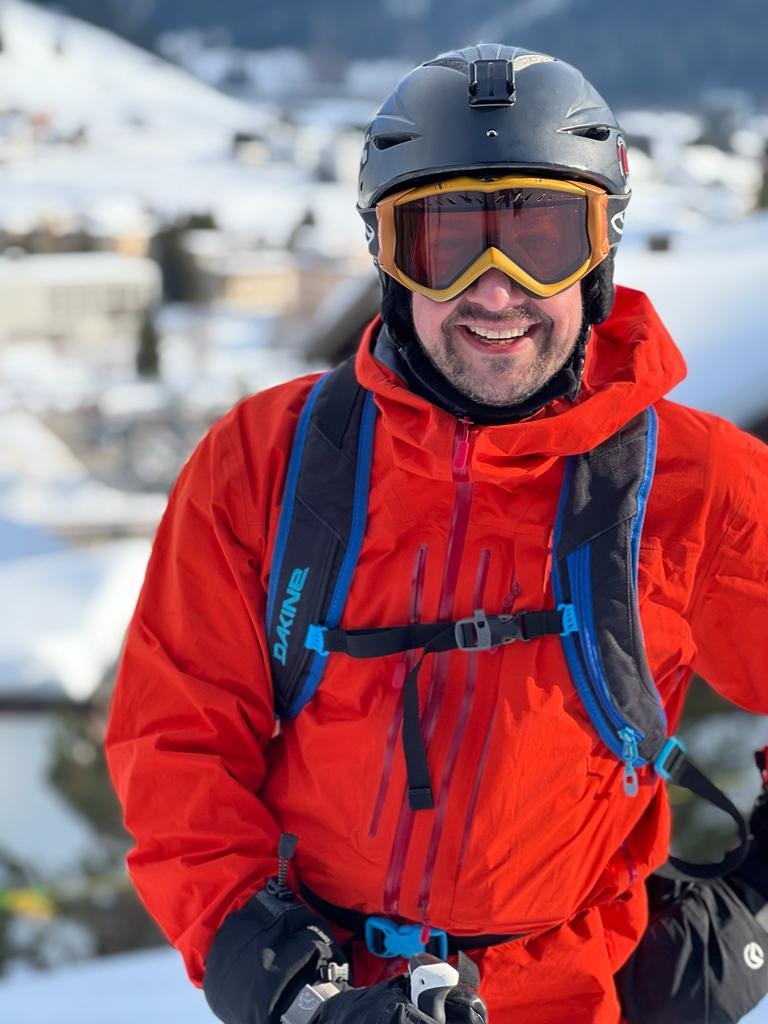
A week of skiing with the kids frightened me more than a month of Christmas. There were moments of the traditional yuletide which pinched me, but in my heart I knew I could cope with each of them. Skiing was different because I didn’t know how it would affect me. Everything about the mountains represents my husband. I could not be on a ski trip and avoid his memory. We must have been skiing together for over 150 days; he went skiing as a child, through university, it got him jobs and nurtured his dreams.
The boy who became my man loved the Earth’s peaks. He remains the only mountain guide I trust. When his body moved downhill, heads would turn to watch him ski. I’d observed this beautiful skier for decades. He did it so well and loved it so much, I found it impossible not to be in love with him on skis.
He didn’t need to care what anyone else thought of him when he skied. He knew he was good; he never had to prove himself. It was a pursuit which consumed him. He adored the non-judgemental, uncompromising freedom of being in a wild open space. The only rules to play with were safety, and he knew how to break them for the sake of good fun. He was speed-limited by a capacity for excellence. He appreciated that the consequences were high and the opportunity infinite. He adored being immersed in a mountain’s natural beauty.
Skiing is a sport with others, although it ultimately relies on individual performance. It requires both wisdom and competence, and he had it all. So it easily created a community for him, because people enjoy it more when he’s doing it with them. Almost every relationship of significance, at every stage in his life, has skiing within it.
We couldn’t talk about skiing after his cancer diagnosis. As far as I’m aware, it’s the only important topic that we never discussed at length. We went skiing as a family in March 2024. Crucially this was the first and only time that he skied with our son. Although my brave husband was in chronic pain on that trip, he still turned heads with his style on the slopes. But we knew something was seriously wrong, because it was the first time ever that he’d not wanted to ski. Four days later he was diagnosed with stage 4 cancer. Inoperable, incurable, treatable for quality, not quantity, of life.
From that moment onwards he knew he’d never ski again. Once he’d accepted that truth into himself it didn’t matter what anyone else said, he didn’t need to talk about it. He was irreparably heartbroken and nobody could remedy his loss. I think the thing he never wanted to contemplate was the idea of not teaching his children to ski.
Ascension
On December 27th 2025, as we ascended the mountain road towards our holiday destination I began to feel sick. The windy switch-backs always make me feel nauseous, but there was something more familiar in the sensation this year. I recognised it as a sense of dread from my everyday path. Like the feeling during a climb on a rollercoaster, you know the drop is coming. As the altitude increased, my body unconsciously braced for being in the mountains, clenching my stomach and squeezing my heart. I was terrified of moving on without him.
If you’ve not been skiing, it’s easy to underestimate the effort involved just to get to the chairlift. The equipment, the many layers of clothing, walking up an icy hill in ski boots, carrying poles and skis (or several pairs in my case). Skiing is an almighty faff, no matter how good you are at it. Once we got into the rigmarole of it all, I could feel my “Mark Energy” kick in. I don’t know how else to explain it, other than it wasn’t me, it was him. On every other ski trip we’d ever taken, even before kids, he did the hard work, not me. I always marvelled at his motivation knowing that without him I’d not have left the accommodation before 10am. Yet here I was, on the piste before the first chairlift started running, with three children beside me. We were ready to ski.
With a boyish vulnerability he told me he could never believe his luck that he met someone who could ski. He said that on the slopes he always felt 16yrs old; a confession which came in his 30s, when he realised that he couldn’t keep up with his own physical ambition. On every ski trip we ever took he always lovingly confided that he was overjoyed to have a girlfriend who skied, and that she chose to marry him was beyond his wildest dreams. Us skiing together made him and therefore me so very happy. The thing is, that until this week I thought skiing was his thing. I used to go because he loved it. To be honest, I was never very bothered about it. He knew that, which is why he regularly skied without me and I never skied without him. But it turns out that it wasn’t just his thing, it was our thing.
There’s a ski trip to define every stage of our relationship. Every step in our lives together has at least one mountain which identifies it. He’d remember the names of the mountains, I only remember the holidays. When we first met, with friends before kids, with family without kids, without anyone else, with our own kids, with other families, in America, in France, in Canada, anywhere that snow landed. Skiing populates our relationship.
I used to complain about the cost, the cold, the uncontrollable conditions, and rigidly held a general trepidation about the challenge in whichever route he’d chosen. Having no control of the terrain used to irritate me immensely. In our early years, his push to make me a better skier used to vex me intensely. We used to argue about it, except he never argued back. So more accurately, I used to quarrel and he’d patiently wait for me to get that I was wrangling with myself. Which made the whole thing even more annoying.
However, after an impressive 540’ jump through life, I’m now the advocate for all that is skiing in our family. The cost is still prohibitively excessive, but I now see that the benefits are invaluable. The lack of control was healing for me, because we’ve experienced worse in recent years. The challenge was negligible, since logistical obstacles and emotional conflict are now my everyday experience. I can handle any terrain, thanks to the lessons he gave me. My physical strength has grown as a coping mechanism for my emotional mountains. As I swooped down the soaring wide piste, cruising fast on my edges, I thought “He gave me this.” I get to go skiing because of him and I loved it a little more than ever before. I can do it in a stoically enjoyable style, because I watched him do it. The trickiest part is that it breaks my heart to know he won’t get to see our kids be skiers.
Embodied Life
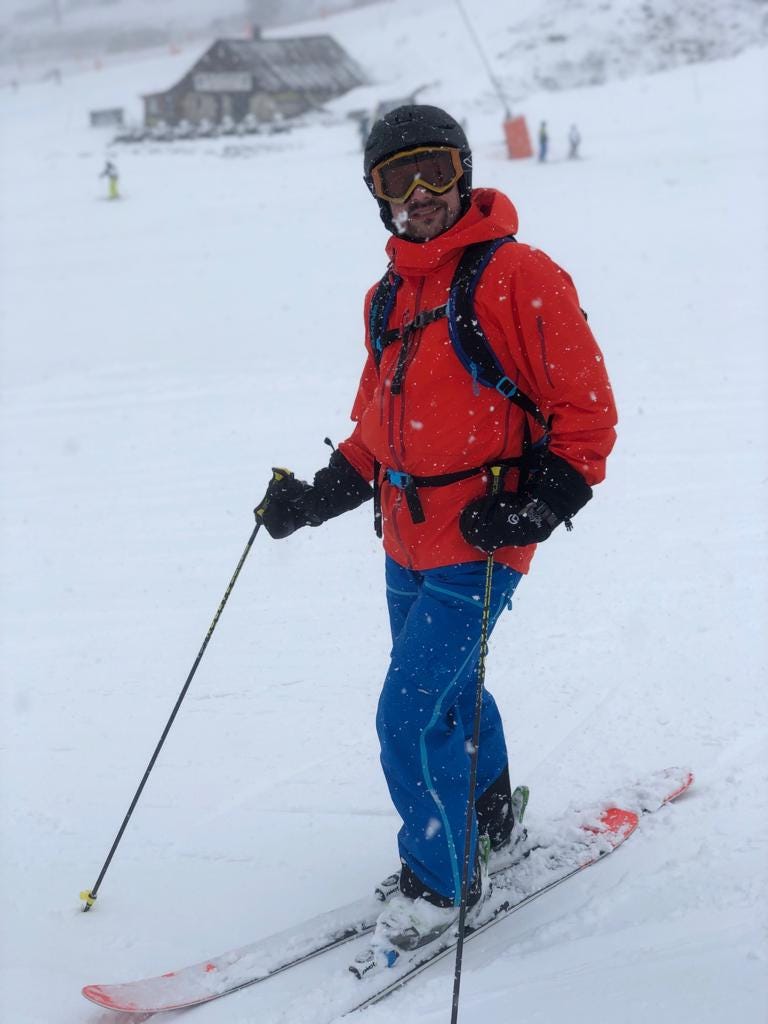
I’ve been wearing his clothes all year. Not everyday, but some days they give me strength and comfort. So it was a natural next step to wear his ski gear on holiday. Not only because his stuff is warmer and better quality than mine, but it made me feel like a guard of honour. The first time I tried on his ski jacket it felt like a giant hug from him. It was so absorbing my knees buckled. There is almost nothing I want more in this universe than to feel his actual physical presence.
While wearing his ski gear, I found myself doing the same movements that I’d watched him do literally a thousand times. My ability to ski didn’t change, but my right hand knew the specific tug needed to open the pocket that held me phone. The way his gloves swung from my wrists while I took our picture was already captured in my unconscious mind. His habitual shuffle of goggles and boot buckle checks at the top of each chairlift became my habits. Without intending to, in his clothes I felt that I became him more. I wanted to be consumed by it.
There were ski runs where he’d have whooped out loud or zoomed off to show me an off-piste jump. He didn’t have to be there for me to sense it. Chairlift rides when he’d have hugged me close and kissed my cheek felt viscerally real. Queues could have lasted for days because we’d have chatted and cuddled through it all. I couldn’t stop the tears from streaming, as my body remembered his powerful repetitive grace. My heart expanded with each familiar movement to let him in or let him out. I don’t know which direction grief travels. Only that the higher altitude gave my heart space to feel where it needed to be.
Being Away
I’ve realised that being away helped me to feel, not to think. Which was a much needed remedy for my December defences. It also helped me to not remember. I was not plagued by sentimental thoughts, “On this day …”, as I’d expected to be. Despite it being “the day”. A year ago he left home and never returned .... A year ago today we agreed to stop his cancer treatment and transfer him to a hospice. Knowing that every detail in each of these days is still stored in my cells, I feared these memories for a year. But on holiday I became so engrossed in the present I forgot the past in relation to its dates.
While being away I remembered him twenty, eighteen, fifteen, twelve, ten, two years ago, skiing and not gone. Forgetting what day it is indicates a great holiday. Perhaps being brave and free is also a remedy for a frightened, broken heart.
I felt guilty at forgetting his pain and simultaneously aware that he didn’t mind at all. It was as though we’d been playing a silly parlour game at Christmas. One partner has to guess the other partner’s answer. It felt as though he already knew that skiing was the answer, and it entertained him to watch me find out. His absence was agonising and his presence was a pleasure I never want to live without.
As we descended the mountain I could feel the physical compression of the trip ending. My eyes streamed as we reduced altitude, my heart squeezed while thinking, “I’ve done it.” We’ve been skiing without him. I wanted to tell him how proud I was of our skiing scions. Our return home was sweet, welcomed and restful after an adventure in the snow. We can be just ourselves again, with a little more grace.
Alive
For a week I’ve time travelled into the embodied memory of my husband - well, strong, excitable, charming and passionate. In the week that he was dying he became alive again for me. It has been one of the most painfully beautiful weeks of my year.
When Mark was in the hospice, a friend sent me “Few Words”, the documentary by Candide Thovex. His pure perfection as a skier, hosted by magnificent mountains, was the last video Mark watched before he died. He’d been sedated, untalkative and sleepy for days, but the freestyle ski champion of the world woke him up. Mark’s eyes were alert while we watched the video together. I could see him drinking in the scenery and absorbing the skill. I asked him what he thought, worried that it had been too much stimulation. His answer is among the last things I remember his voice saying, “Fucking brilliant”.
You are "fucking brilliant", Rach: "The ability to say “no” or stop; the willingness to slow down; intelligence to read the landscape; being silent for long enough to hear the signals; doing the next best thing, even if it’s difficult or unpopular."... this all feels like impossible-to-achieve wisdom. But you're doing it. Love the description of Mark-energy on the mountain, too xx
I don't really know how you did it but you did. To find comfort and beauty in that "first" takes bravery and focus. I love this post and bravo to your friends who asked you - "do you want to come skiing?"